

moto: Information Systems Students Develop Software for School-Age Childcare
What began as a project seminar has grown into a startup venture with real future potential: In the winter semester 2023/24, Information Systems students developed moto, a digital solution for school-age childcare at Altenberge Primary School. The project originated in the seminar "Developing a Coordination App for Open All-Day Care at Altenberge Primary School" at Prof. Tobias Brandt's Chair of Digital Innovation and the Public Sector.
The background to the project was Germany's "Ganztagsförderungsgesetz (GaFöG)", which will gradually introduce a legal entitlement to all-day care for primary school children starting in 2026. As a result, OGS Altenberge, an open all-day school programme in Germany, also expects rising numbers of children in care and a growing organisational workload. In response to this need, the project seminar was launched in collaboration with the University of Münster and became the starting point for moto.
Together with the Municipality of Altenberge and OGS Altenberge, the students developed a platform designed to simplify the organisation of before- and after-school care and support educational staff in their day-to-day work. Its features include the management of attendance, rooms, and staff, as well as digital location tracking of children using NFC technology.
To further develop moto, the chair received funding of €150,000 through the DATIpilot programme. moto is now also funded through the EXIST programme. Florian Lüttgenau and Yannick Wenger, who both took part in the original seminar, have continued working on moto ever since. Together with Conrad Reintjes, who also studied Information Systems and is responsible for product and customer relations as CPO, they are now driving the next stage of the platform's development.
We spoke with them about their motivation, the challenges they faced during development, and the future of moto.
How did the idea for the project emerge, and what problem are you trying to solve?
The idea emerged in the winter semester 2023/24 in a project seminar on the digital coordination of school-age childcare in Altenberge. The starting point was an NFC prototype that allowed children to check in and out of the childcare programme at different check-in points. In discussions with OGS Altenberge, we quickly realised that the actual problem was much broader: in everyday childcare, a lot of information is still handled through paper lists, verbal communication, individual emails, or disconnected systems.
Starting in the 2026/27 school year, children entering first grade have a legal entitlement to all-day care, which will be extended to all primary school grades by 2029/30. This reform makes the problem even more pressing. As a result, many school-age childcare sites will need to care for more children and coordinate more processes in the future. At the same time, there are still very few software solutions in this field that bring together the different needs of care teams, management, parents, HR administration, and providers in one system. Daycare centres have been working digitally in many areas for years, while care teams in these programmes often still rely on highly analogue structures.
This is how moto came about: software for school-age childcare that brings attendance tracking, child information, parent communication, administration, staffing, time tracking, holiday care and online enrolment together in one system. Our goal is to reduce the organisational burden on educational teams so that they have more time to work with the children. Especially as the number of children in care increases and coordination becomes more complex, digital processes and, depending on the facility, NFC check-in systems can offer major benefits.
What role does each of you play on the project team?
We each contribute different strengths to the project. Florian mainly focuses on strategy, organisation, and collaboration with funding partners. As CTO, Yannick leads development: he builds the product, is responsible for the technical architecture, and takes care of the platform's scaling and infrastructure. As CPO, Conrad is responsible for the product and customer relations. He works directly with schools and providers, represents moto at trade fairs, and translates practical feedback into concrete features.
We are now a team of six. Alongside the three of us founders, Christian Kamann, who was already part of the original project seminar, supports us in development. Tristan Heitger also works on development and design. Jule Soll supports customer outreach, marketing and customer support. As more schools and care providers join us, our team is growing too, and we are looking for more people to join us.
Many decisions are made directly on the basis of feedback from the institutions that already use moto in everyday practice. That is very important to us, because good software for before- and after-school care only works if it is developed close to the teams' real workflows.
What was the biggest challenge during development?
The biggest challenge was realizing that there is no one-size-fits-all solution in school-age childcare. Every institution works differently, and needs become even more diverse as the number of children increases. One school wants to document attendance digitally with NFC wristbands, while another prefers to handle it directly in the app. For some providers, staff administration is the key issue; for others, it is parent communication, holiday care, or something else.
That is why we had to think of moto as a highly modular system from the very beginning. Today, the platform works like a toolkit: institutions and providers can use the building blocks that fit their workflows. Implementing this modularity in a technically clean way while keeping the system easy to use was, and still is, one of our most important tasks.
How did the collaboration with OGS Altenberge and the municipality work?
The collaboration was extremely valuable for us because it allowed us to develop very close to practice. OGS Altenberge and the municipality gave us insights into real processes, tested prototypes, and provided very open feedback on what works well in everyday operations and what creates additional effort.
That honest feedback has had a major influence on moto. Step by step, an initial technical idea became a solution based on the real needs of care staff.
What surprised you most about the project?
What surprised us most was how much is actually missing in school-age childcare once you take a closer look. We started with a single question: Where is each child right now? But in conversations with the teams, more questions quickly followed. Who is picking up today? Who is off sick? Who is covering for an absent colleague? How does enrolment for holiday care work? We realised that every well-solved building block immediately shows where the next one is missing. Step by step, a single feature grew into an entire ecosystem.
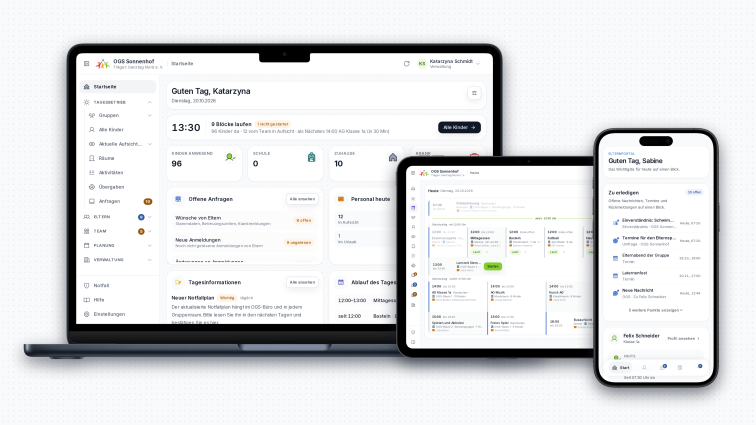
Today, moto consists of four connected apps. The staff app shows staff during the afternoon which child is where, when each child will be picked up, and what has changed at short notice. The management app brings together enrolments, child data, care times, groups, activity clubs, holiday care, and the staff schedule, including cover arrangements and time tracking. In the parent app, which is available in many languages, parents report their child sick, change pick-up times, manage who is authorised to pick up their child, and receive messages, questions, and documents. The provider app connects staff, holiday care, and administration across multiple sites. Attendance tracking via app or NFC is still central, because that is where it all started. Today, however, it is just one building block among many.
We were also surprised by how quickly teams start working with the system. If the interface is clear and solves a real everyday problem, moto is used very intuitively. The biggest effect comes where the building blocks work together. An absence report from the parent app goes straight to the team, without a paper slip or a call to the office. A staff absence is immediately visible in the staff schedule. When everyone is on the same page, the afternoon becomes noticeably calmer.
What does the DATIpilot funding mean to you personally and for the further development of the project?
The DATIpilot funding was a decisive step for us. After the seminar, it gave us the opportunity to continue working on moto, build the project more professionally, and make the first product decisions with more time and structure.
On a personal level, the funding also confirmed for us that the problem is socially relevant. School-age childcare in Germany is facing major organisational challenges due to the new legal entitlement. DATIpilot helped us turn a project seminar into a robust product. moto is now in use at more than 15 schools in North Rhine-Westphalia and Lower Saxony and is used daily by several thousand children and their care teams.
What will the next phase of development for moto look like?
We are very pleased that we have received follow-up funding through the EXIST program. This means moto is now entering its next phase of development. A great deal has already happened in recent months: we have connected additional schools in North Rhine-Westphalia and Lower Saxony, we are operating in everyday practice, and we have learned a lot from the on-site teams about different childcare structures.
Now we want to grow. moto has proven itself in everyday practice, and we want to bring it to many more schools. That is why we are looking for care teams, schools and providers who would like to get started with us, including beyond North Rhine-Westphalia and Lower Saxony. Every new institution brings its own workflows. That is exactly what we learn from, and it is how we develop all four apps in a targeted way. We are working especially intensively on the provider app, which gives providers with multiple sites an overview across all their locations. Our focus remains on ensuring that moto adapts to the institutions' workflows, not the other way around.
What is your long-term vision for the project? What impact should moto have beyond Altenberge?
Our long-term vision is for moto to provide noticeable relief for school-age childcare teams and providers across Germany. If less time is spent on lists, searching, coordination, paperwork, and duplicate documentation, more time remains for educational work.
We are particularly interested in larger provider constellations with multiple sites. In those settings, digital structures can help implement shared standards without losing the specific characteristics of individual institutions. That is exactly the impact we want to create: more transparency, less administrative effort, and better collaboration between care staff, parents, schools and providers.
Beyond the founders' personal insights, moto also shows the potential of an Information Systems degree and project-based learning: a project seminar can develop into a practical solution with social impact and entrepreneurial potential.
Links related to this news