

What's Next? From Studying Information Systems to IT Consulting
Finn Petersen earned his bachelor’s degree in Information Systems and his master’s degree in Information Systems at the Department of Information Systems at the University of Münster. During his studies, he also gained practical experience as an e-learning developer support specialist and through working student positions in product management and content management.
Today, Finn works as an IT consultant at BBHT Beratungsgesellschaft mbH & Co. KG, a Münster-based consulting firm specializing in IT, digitalization and business processes.
We spoke with Finn about his time as a student, the practical experience he gained during his studies and his path into IT consulting.
Why did you choose to study Information Systems, and which subjects or topics interested you most during your studies?
When I graduated from high school, I wasn’t quite sure what I wanted to do later on, so I wanted to keep my options relatively open. That’s why I considered which degree programs would best suit my strengths and leave various career paths open to me. I simply found the interplay between aspects of computer science and a business management perspective very interesting. During my studies, I particularly enjoyed the lectures on project and process management. But I also have fond memories of the project seminars and other seminars, which were a lot of fun because they offered a nice change from the typical lecture format.
You gained practical experience during your studies, including in e-learning and through working student positions in product management and content management. How did these opportunities come about, and how did they prepare you for your current career?
To be honest, for financial reasons, working alongside my studies was never really a question of whether I would do it or not. After a few jobs that weren’t related to my field, I eventually thought, “If I’m going to work anyway, I might as well gain some relevant experience.” I got the job through a friend and stayed in it until I graduated.The experience prepared me mainly by familiarizing me with workplace structures and the way colleagues work together. Even today, I see communication and collaboration within a team as essential parts of the job. Of course, structures and regular meetings help with this, but so do soft skills like facilitating discussions, etc., and those are best learned through hands-on experience.
How did you get into IT consulting after graduating, and what appealed to you about this field?
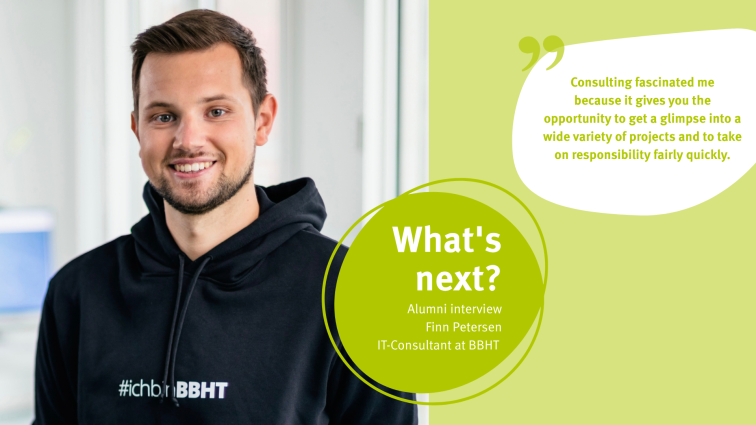
Consulting itself fascinated me because it gives you the opportunity to get a glimpse into a wide variety of projects and to take on responsibility fairly quickly. I ended up at BBHT through my master’s thesis. During that half-year, I gained a very good insight into the company and decided that it was a great place to start my career.
What exactly does an IT consultant do, and what does your typical workday at BBHT look like?
Of course, this depends a lot on the project, the current phase, and the team composition. I’m currently working on a project where we’ve been doing application development in a very agile way, starting with a very small team and now with a larger one. At first, I worked as a business analyst and tester, then briefly as a Scrum Master, and now I’m responsible for the project on the BBHT side. As a result, my day-to-day work depends quite a bit on whether there are new colleagues who need to be onboarded, etc. Generally, I start my mornings by getting an overview of the day so I can go into the daily stand-up meeting prepared. Then we have quite a few meetings and coordination sessions in the morning, and in the afternoon I usually have time to work on things and make progress on the design of new features. Of course, I’m not just working on the project – there are always tasks that come up within BBHT as well. For example, business analysis or Scrum training sessions, which I prepare and lead with other colleagues (last year, even with some participants from WINet).
What kinds of projects or topics do you particularly enjoy working on at the moment?
I actually really enjoy preparing and conducting training sessions, partly because it’s always a nice change of pace from day-to-day project work. But I also still enjoy working on my project, since we’re constantly receiving new requirements and, in addition to processing data extracted by AI (which was our core focus at the beginning), we’re continually taking on new responsibilities. This means I have to familiarize myself with new topics every now and then, which also gives me a sense of accomplishment whenever I’ve mastered a new subject.
In what ways is working as an IT consultant different from what you expected during your studies?
Primarily in terms of the extent to which soft project factors influence overall project success. Our team works so well primarily because we collaborate very effectively and can support each other’s work. In addition, we’ve created a very open feedback culture and a level of trust that gives everyone the feeling they can contribute to important decisions. I’m firmly convinced that this is the only way my colleagues and I can make the best possible use of our skills.
What was the biggest challenge for you personally when starting your career, and how did you deal with it?
The transition was certainly interesting, but I experienced it as a positive one overall. As a student, you feel like you’re never really finished: there’s always more to learn, lectures to catch up on or presentations to prepare. Toward the end of my studies, that was starting to frustrate me. So I really enjoyed being able to switch off properly after work or at the weekend.
Of course, not everything is easy. Depending on the project, you do give up some of the independence you have as a student which is probably at its highest then. When choosing where to start my career, I made sure to find a role that would allow me to retain as much of that independence as possible. All in all, I didn’t find the transition into working life particularly challenging. The biggest adjustment was probably getting used to a new sleep schedule.
What advice would you give today’s Information Systems students who are interested in a career in IT consulting?
I think it’s incredibly helpful to look beyond your immediate field of study early on and explore topics that go beyond what’s covered in lectures. It’s also worth looking into different consulting firms, because consulting can mean very different things. Starting out in strategy or management consulting certainly requires different skills from the more operational work I do.
I was lucky enough to interview people from a range of consulting firms for my master’s thesis. That gave me a clearer picture of the different options and helped me figure out what I wanted. It definitely helped me make my decision. So I’d recommend taking every opportunity to explore the field, work out whether it’s right for you and, if it is, think about what kind of consulting you can see yourself doing.