


Dr. Adam Widera’s 25th Anniversary at the University of Münster
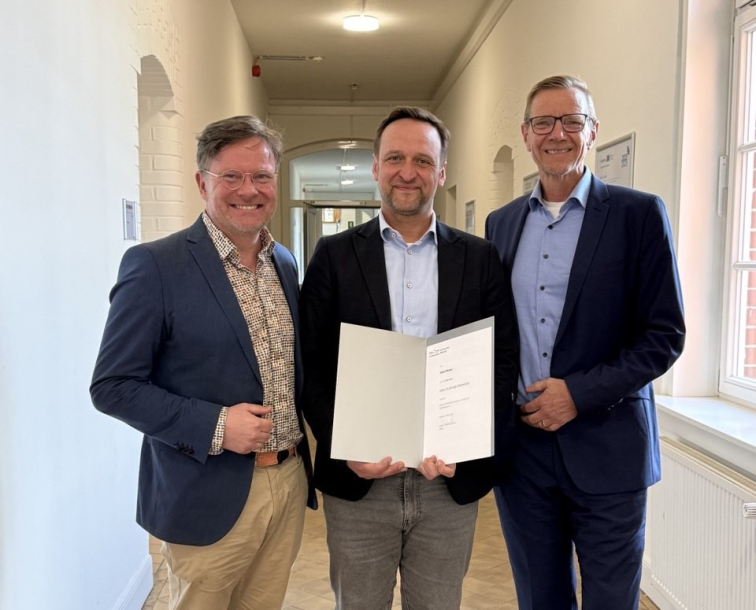
For many years, Dr. Adam Widera has shaped the Department of Information Systems at the University of Münster with his dedication and expertise. His academic journey at the university began early: while studying political science, philosophy, and political economy, he worked as a student assistant at the Institute for Political Science from 2002 to 2005.
Afterwards, he worked initially as a research associate at the Chair of Political Science and International/Comparative Political Economy before joining the Department of Information Systems in 2006. There, he first served as a project coordinator in the BMBF-funded project “Computer-Assisted Higher Education”, at the Chair of Information Systems and Controlling. He later supported the Chair of Information Systems and Logistics as managing director and lecturer, where he discovered his passion for humanitarian logistics and crisis management and completed his doctorate in this field.
In December 2013, Adam Widera and Prof. Dr.-Ing. Bernd Hellingrath founded the ERCIS Competence Center Crisis Management (C³M). As Managing Director, he plays a key role in shaping the center’s work and future development. Over the past years, he has successfully acquired several national and international research projects, helping C³M become an important actor within various research and practice networks. In 2020, Adam Widera additionally took on the role of Deputy Managing Director of the department and, since this year, has joined the executive board of the ERCIS Flow Factory as managing director.
On the occasion of his 25th anniversary, we asked him a few questions:
You originally studied political science, philosophy, and economic policy – how did you end up at the Department of Information Systems?
After completing my magister degree, I contributed to a study and quickly realized that I was missing a stronger practical orientation and greater research impact. At the same time, I was involved in an EU project in which the Department of Information Systems was also participating through our current director, Prof. Dr. Jan vom Brocke. Through this, I came across the exciting project “Computer-Assisted Higher Education,” where a position as project coordinator had become available. I did not hesitate for long and applied immediately. Information Systems quickly became my new academic home.
You have been working at the department for many years – first as a project coordinator and later as a research associate at the Chair of Information Systems and Logistics, where you also completed your doctorate. Which projects or experiences were particularly formative for you during this time?
I could name many highlights here. However, if I had to emphasize one project, it would be DRIVER+, the largest EU-funded crisis management project to date, involving more than forty partners from across Europe. The project was not only interesting because, as the competence center, we were able to test and evaluate various research results together with crisis management practitioners under realistic conditions, but also because, as the only university institution in the consortium, we were able to develop and test a novel, practice-driven evaluation approach – the Trial Guidance Methodology (TGM) – in collaboration with the European Commission’s Joint Research Center. Unfortunately, the reality of research funding is often that project results are forgotten once a project ends. With TGM, however, things were very different. The methodology was adopted by many stakeholders in security research and applied in numerous initiatives and research projects. A particular highlight last year was certainly receiving the Security Innovation Award from the European Commission and DG HOME in the category “Best Open Source Innovation 2025.”
You have been Managing Director of the ERCIS Competence Center Crisis Management (C³M) since 2013. How have the center and your work there evolved over the past few years?
After initially focusing on logistical processes and information systems in international disaster management, we increasingly expanded our perspective toward European and regional challenges through successfully acquired research projects. Especially since the outbreak of the COVID-19 pandemic, our research has focused more strongly on national and municipal civil protection. Alongside this development, our stakeholder landscape has broadened significantly, so that in addition to international non-governmental organizations, various emergency response organizations and public authorities have become long-standing practice partners.
The entire department thanks Adam Widera for his excellent work, loyalty, and continued commitment. We look forward to many more years of successful collaboration.