


AI4Forest research project receives computing resources from the JUPITER supercomputer
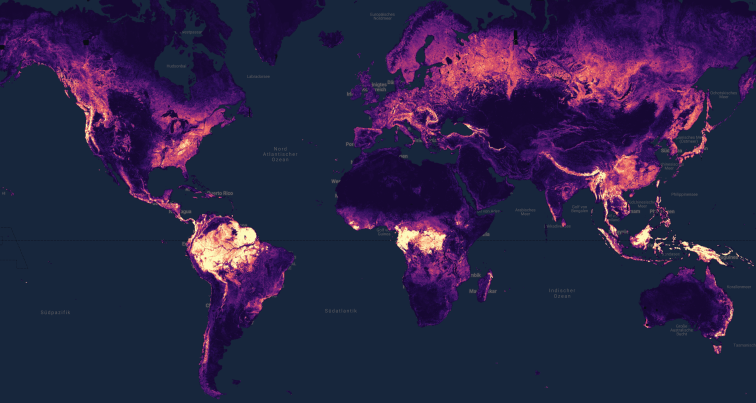
To support the development of high-resolution global biomass maps, the AI4Forest project has been granted access to the computing resources of JUPITER at Forschungszentrum Jülich, Europe’s first exascale supercomputer. In total, the project will have access to 120,000 GPU hours, which will be used to process large volumes of Earth observation data.
AI4Forest is a German-French research cooperation that investigates how cutting-edge artificial intelligence methods can help to better understand, monitor, and respond to the stresses on forest ecosystems caused by climate change. The project is coordinated by Philippe Ciais (Laboratoire des Sciences du Climat et de l'Environnement, Université Paris), Alexandre d’Aspremont (Department of Computer Science, École Normale Supérieure), Fabian Gieseke (Department of Information Systems, University of Münster), Sebastian Pokutta (Zuse Institute Berlin), and Cornelius Senf (Earth Observation for Ecosystem Management, Technical University of Munich).
The goal of the proposal for computing resources is to create a global aboveground biomass (AGB) map that builds on the research group’s previous work: ECHOSAT; European satellites (Sentinel-1, Sentinel-2); Japanese satellites (ALOS Palsar-2); American sensors (GEDI); and German satellites (Tandem-X DEM).
Above-ground biomass comprises the plant biomass above the soil surface. AI4Forest focuses in particular on trees, as they store large amounts of CO₂ and are simultaneously increasingly exposed to various threats such as drought, heat, fires, or pest infestations.
Traditionally, biomass has been primarily measured or estimated through on-site field surveys. AI4Forest aims to improve such estimates on a global scale using satellite data and artificial intelligence, and to make them available more efficiently.
Creating such maps requires a great deal of computational power. Access to high-performance computing resources is crucial for processing large amounts of data and training complex AI models. The research group is especially pleased to be able to rely on JUPITER for this work.
Links related to this news