


What’s Next? From Information Systems to a Career in Data Science
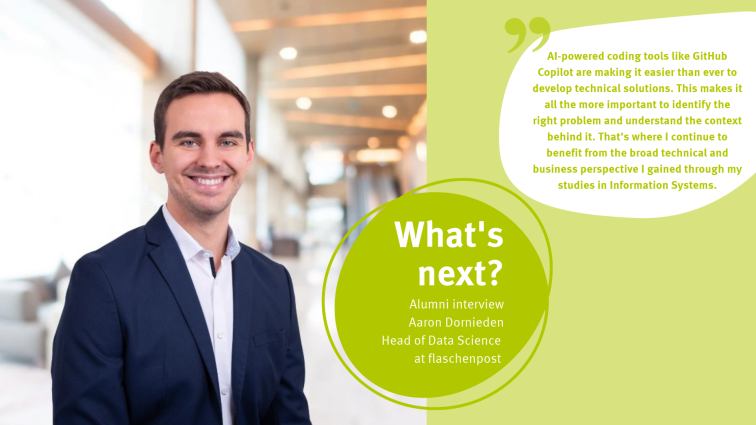
How does an Information Systems student become Head of Data Science? For Aaron Dornieden, this journey began at the University of Münster. While studying Information Systems, he gained his first hands-on experience in data analytics at flaschenpost, a leading online retailer for food and beverages in Germany. He remained connected to the company as a working student even during his master’s program at the Technical University of Munich.
Today, Aaron is Head of Data Science - E-Commerce at flaschenpost. In this role, he is responsible for the data science strategy and its implementation in e-commerce. Together with his team, he develops data-driven solutions for recommender systems, intelligent search, and generative AI applications. These solutions help create a personalized shopping experience and contribute significantly to the company’s success.
We spoke with Aaron about his time as a student in Münster, his path from his first hands-on experience to a leadership position, and his current work at the intersection of data science and e-commerce.
How did you first hear about the bachelor’s program in Information Systems at the University of Münster?
I’ve actually always been interested in computer science, certainly influenced by my father, who sparked my enthusiasm for the subject at an early age. Computer science was a constant part of my school life and eventually became one of my subjects for the “Abitur”. When choosing a degree program, I was particularly drawn to the combination of computer science and business, as I was fascinated by the idea of using technology to create tangible, measurable impact.
Several factors spoke in favor of Münster: The Information Systems program has an excellent reputation, the curriculum was a great fit for my interests, and at the same time, Münster is an incredibly attractive city to study in. In the end, this combination made the decision pretty easy for me.
Was there a project, course, or person who had a particularly strong influence on you during your studies?
There were actually quite a few. Academically, I especially remember the data management course. That’s where I learned important fundamentals for working with databases, which later proved to be of enormous benefit to me, especially as I took my first steps in data analytics and data science.
The entire field of quantitative methods was also influential. I still use the statistical foundations I learned there, for example, when analyzing and interpreting A/B tests. I also always enjoyed the computer science courses, with their many hands-on exercises.
A real highlight for me was the project seminar, where we developed an online marketplace for local retailers as a team. Working together over an extended period on a larger, real-world project was a completely different experience from solving individual exercises. It allowed us to bring together much of what we’d learned in our studies while gaining experience in teamwork and collaborative problem-solving.
I also remember several of the teaching approaches used in the program—especially the flipped classroom format in Dr. Jens Lechtenbörger’s course, as well as Nand2Tetris and various gamification approaches. These formats conveyed technical content in a highly motivating and application-oriented way.
Which knowledge or skills from your studies are especially useful in your work today?
I still benefit from many of the foundational concepts I learned, especially data management and statistics, but also, more fundamentally, the way of thinking within information systems. Understanding complex processes, structuring them, and then systematically optimizing them is now part of my daily work.
The broader skills I developed during my studies are just as important: project work and, above all, the ability to quickly familiarize myself with new topics and work independently. For me, the degree wasn’t the end of the learning process; it was a foundation for lifelong learning. Especially today, when technologies and requirements are changing at an extremely rapid pace, this skill is becoming increasingly important.
I also find the broad education I received in Information Systems particularly valuable. The fundamentals of business administration help me immensely in approaching technical issues from a business perspective as well. In my current role, I often serve as a bridge between technical teams and management. Understanding both “languages” and being able to translate between them is extremely helpful in this regard. At the same time, this broad perspective helps me grasp processes and interrelationships holistically—even beyond individual technologies or industry contexts—and derive appropriate solutions from them.
You completed an internship in data analytics at flaschenpost during your bachelor’s degree and continued working there as a working student during your master’s degree. How did that come about, and how did your role at the company develop?
In the fifth semester of my bachelor’s program, an company internship was required as part of the logistics management seminar. At the time, flaschenpost’s first delivery vans were just starting to appear around Münster, and I immediately found the business model interesting. For me, it was a great opportunity to take a look behind the scenes at a young, fast-growing company.
Everyone at flaschenpost welcomed me warmly, and I was given the opportunity to take on responsibility extremely quickly. During the internship, I was able to work closely on analyses related to route planning, and I felt that my work was making a tangible difference. That strengthened my interest in using data to solve concrete problems and measurably improve processes.
After the internship, I stayed on as a working student at flaschenpost, even while pursuing my master’s degree in Munich. My work gradually shifted from pure data analysis toward data science. Among other things, I developed the first machine learning models for various estimates related to route planning. For my master’s thesis, I shifted my focus to e-commerce: I developed and evaluated a number of recommender systems and was able to measure their value through various A/B tests. That was ultimately the starting point for the topic of personalization, which continues to be a focus for me to this day.
After completing my master’s degree, I joined the company as a full-time data scientist in early 2021. I continued rolling out the recommender systems and launched additional data science projects, including work on churn prediction. Later that same year, I took on my first leadership responsibilities as a team lead. Together with my team, I was able to significantly expand personalization over the following years.
Since early 2024, I’ve been Head of Data Science - E-Commerce. Today, my team and I are responsible for the strategy, development, and operation of our e-commerce data science solutions—from personalizing almost every page in the online store to intelligent search and new generative AI applications.
What technical and personal skills are particularly in demand in your current position as Head of Data Science – E-Commerce?
Of course, you need a strong technical foundation—from data modeling and analytical thinking to a solid understanding of machine learning. It’s also extremely important in our field to keep developing your skills. Technology is changing incredibly quickly, so I think it’s important to stay curious and try out new approaches. At flaschenpost, for example, we hold a hackathon every year. In recent years, we’ve developed some exciting solutions in the area of generative AI.
Soft skills are just as important, and I think new technologies are making them even more important. You need to be able to explain complex technical topics in a way that makes sense to different audiences—whether you’re talking to data scientists, product teams, or management. Data storytelling is also important to me: An analysis or model alone doesn’t create value. What matters is communicating the key insights clearly, bringing different perspectives together, and turning those insights into concrete decisions and actions.
In a leadership role, prioritization as well as team leadership and people management come into play. Since there are always more exciting ideas than can be implemented at once, it’s important to set the right priorities. And ultimately, for me, it’s also about creating a work environment where my employees enjoy their work and can continuously develop their skills.
What would you have liked to know when you started your studies?
Back then, I also considered studying computer science, like my father. Looking back, though, I’m very glad I chose Information Systems. What I know now is that you don’t have to specialize too much at the beginning of your studies. A broad academic foundation is incredibly valuable—specialization can come later.
Today, more than ever, I realize how important it is not only to master individual technologies, but also to understand processes, businesses, and the relevant field. AI-powered coding tools like GitHub Copilot are making it easier than ever to develop technical solutions. This makes it all the more important to identify the right problem and understand the context behind it. That’s where I continue to benefit from the broad technical and business perspective I gained through my studies in Information Systems.
Another thing I hadn’t expected when I started university was just how important the relationships I built during my studies would become. I remain incredibly grateful for that to this day. I met some of my closest friends during my bachelor’s and master’s programs, and many of these connections remain with me to this day. I find it especially wonderful that former fellow students from both my bachelor’s and master’s programs now work with me on the same team. For me, therefore, my time at university was incredibly enriching—not only professionally and academically, but above all on a personal level.
What advice would you give to students who are still unsure which career path they want to pursue?
Try to gain as much practical experience as you can while you’re studying, both inside and outside the university. Internships and student jobs are a great way to explore different kinds of work and figure out what you really enjoy. I’d also encourage students to make the most of the hands-on parts of their program. A project seminar, for example, gives you the chance to contribute to a shared project over time and gain experience that goes well beyond the subject matter itself.
After all, it’s not just technical knowledge that counts in everyday professional life. In my view, rapid technological progress is making soft skills even more important: working as part of a team, bringing together different perspectives, communicating results clearly, and developing solutions collaboratively. I benefit enormously from these skills today.
And you don’t have to know exactly where you want to end up professionally right from the start. Studying is the perfect time to try things out, explore your own interests, and gradually find your own path. You can always specialize later.